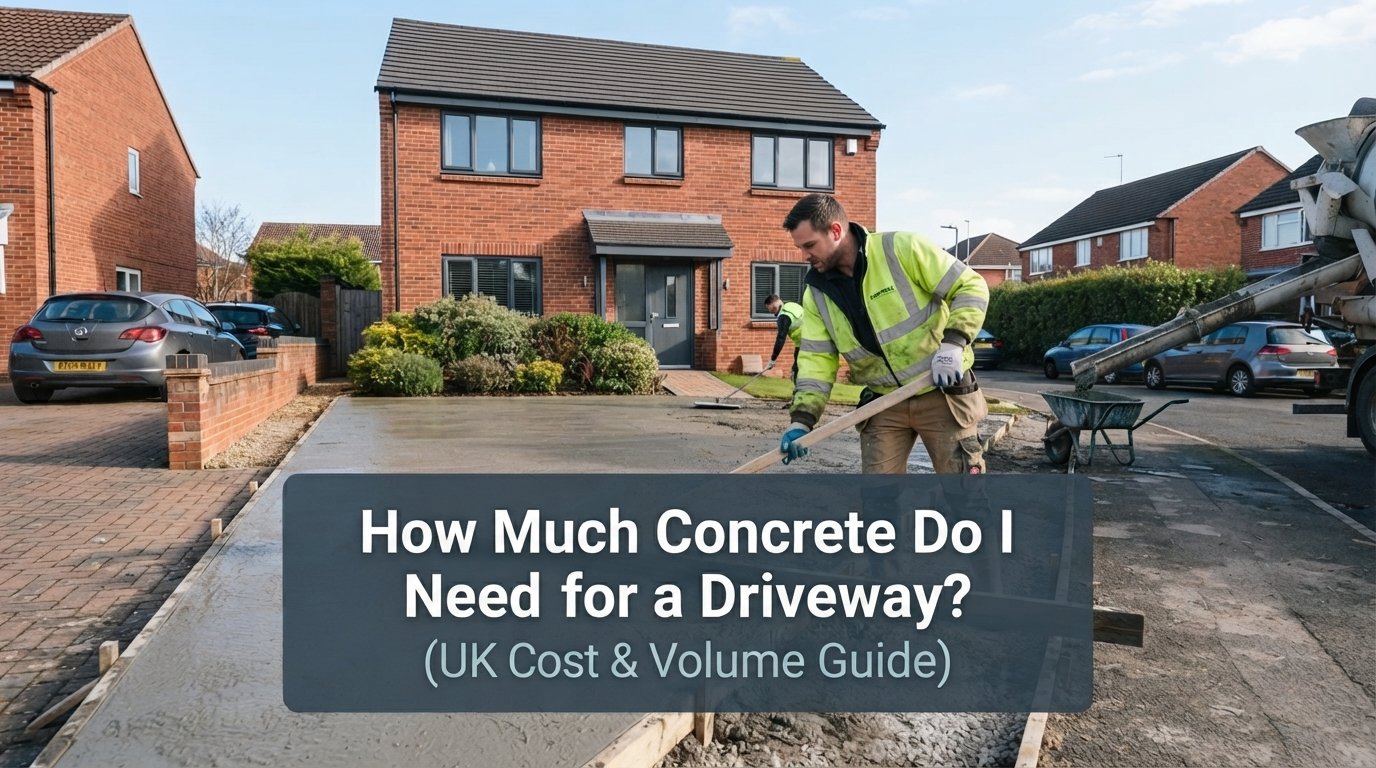

If you’ve started pricing up a new driveway, you’ve probably noticed that concrete suppliers don’t quote in square metres — they quote in cubic metres. That one detail trips up more homeowners than anything else in the whole project. Get the volume wrong and you’re either paying for a wasted half-load or standing in your garden at 4pm on a Friday realising you’re 0.3m³ short with a lorry that’s already gone home.
This guide walks through exactly how much concrete you need for a driveway in the UK, how to work out the volume yourself, what it actually costs in 2026, and the thickness rules that determine whether your driveway lasts twenty years or cracks within two winters.
The Short Answer
For a typical UK domestic driveway, you’ll need concrete at a depth of 100mm for cars and 150mm for larger vehicles, vans, or anywhere with regular heavy traffic. To get your volume in cubic metres, multiply length × width × depth (in metres), then add 10% for wastage, spillage, and an uneven sub-base.
So for a standard 5m x 3m driveway at 100mm thick:
5 × 3 × 0.1 = 1.5m³, plus 10% wastage = 1.65m³
Most suppliers round this up to a full load, since small orders attract a surcharge. That’s the quick version — but the details matter, so let’s break it down properly.
Step 1: Measure Your Driveway Area
Before you can think about volume, you need an accurate area. Grab a tape measure (a laser measure is even better if you have access to one) and measure:
- Length — the longest run of the driveway, in metres
- Width — measured at a couple of points if the shape isn’t perfectly rectangular, then averaged
If your driveway isn’t a simple rectangle — say it’s L-shaped, has a curved edge, or widens out near a garage — split it into two or three simpler shapes, calculate each area separately, then add them together. It’s far more accurate than trying to estimate one irregular polygon.
Example: L-shaped driveway
- Main section: 6m x 3m = 18m²
- Side extension to the garage: 2.5m x 2m = 5m²
- Total area: 23m²
Don’t forget to measure any areas that will be a different thickness — for instance, if part of the drive is a turning area for a van or motorhome, that section may need to be poured deeper than the rest.
Step 2: Decide on Driveway Concrete Thickness
This is the step people most often get wrong, usually by copying a number from a forum post without checking whether it applies to their situation. Driveway concrete thickness in the UK depends on what’s going to be driving on it, and getting it wrong either wastes money (over-specifying) or shortens the driveway’s life dramatically (under-specifying).
| Application | Recommended thickness | Notes |
|---|---|---|
| Footpaths, garden paths | 75–100mm | Foot traffic only |
| Standard car driveway | 100mm | Cars, small hatchbacks, everyday use |
| Driveway with heavier cars / occasional van | 125–150mm | SUVs, people carriers, light commercial vehicles |
| Driveway for vans, motorhomes, or HGV access | 150–200mm | Reinforced with mesh; consult a structural engineer for anything above domestic van weight |
| Shed base / low-traffic slab | 75–100mm | Not a driveway spec, included for comparison |
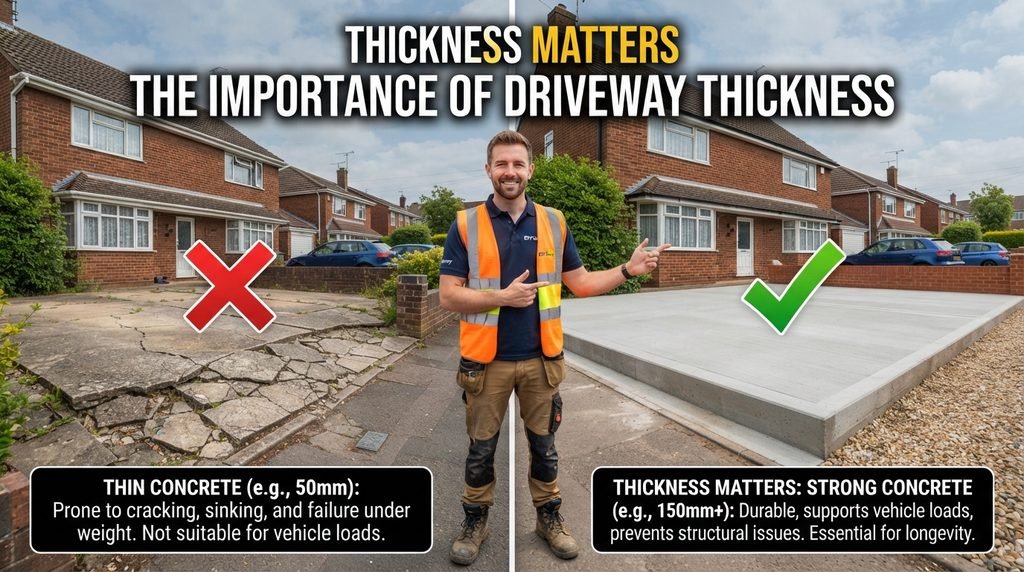
Alongside thickness, the concrete grade matters just as much. This is where a lot of quotes go wrong — a driveway poured in the wrong grade of concrete can look fine on day one and start cracking under vehicle weight within a single winter of freeze-thaw cycles.
- C20/25 — general purpose, fine for foundations and blinding, but too weak for a trafficked driveway. Avoid for this application even though it’s cheaper.
- C25/30 — a common “domestic” mix, but many concrete suppliers now specifically recommend against it for driveways because it lacks air entrainment and can scale (flake at the surface) under freeze-thaw conditions.
- C30/37 (PAV1) — this is the mix most reputable UK suppliers actually specify for a standard domestic driveway. It’s designed with air entrainment for frost resistance and is rated for regular car traffic.
- C32/40 (PAV2) — for driveways that see heavier or more frequent traffic, such as vans or multiple vehicles.
If in doubt, tell your supplier it’s for a driveway rather than just asking for “concrete” — most will automatically quote you the correct paving-grade mix (PAV1 or PAV2) rather than a generic structural grade.
A quick word on sub-base: the concrete slab itself is only part of the build-up. Almost every UK driveway needs a compacted MOT Type 1 sub-base underneath — typically 100–150mm deep on top of firm, well-drained ground, more if the existing ground is soft clay or poorly draining. This sub-base isn’t concrete, but you’ll need to budget and order for it separately, and it affects your total dig-out depth.
Step 3: Calculate the Volume of Concrete Needed
Once you know your area and your thickness, the formula is straightforward:
Volume (m³) = Length (m) × Width (m) × Depth (m)
If you’ve already worked out your total area in square metres, you can simplify it to:
Volume (m³) = Area (m²) × Depth (m)
Worked Examples
Small single driveway — 4m x 2.5m at 100mm 4 × 2.5 × 0.1 = 1.0m³ Plus 10% wastage = 1.1m³
Standard double driveway — 6m x 5m at 100mm 6 × 5 × 0.1 = 3.0m³ Plus 10% wastage = 3.3m³
Large driveway with van access — 8m x 6m at 150mm 8 × 6 × 0.15 = 7.2m³ Plus 10% wastage = 7.92m³, typically rounded up to 8m³
Quick reference rule of thumb: 1 cubic metre of concrete covers roughly 10 square metres at 100mm depth. So if you know your square metreage, divide by 10 to get a rough cubic metre figure at standard depth, then add your wastage allowance.
Why Add 10%?
Wastage isn’t a scam or a padding trick — it accounts for real, unavoidable factors:
- Ground that isn’t perfectly level, meaning some areas take more concrete than the flat calculation suggests
- Minor spillage and overfill at the edges of formwork/shuttering
- Compaction of the sub-base being slightly uneven on the day
- Small measurement errors that are almost impossible to avoid on-site
Skimping on this buffer is one of the most common reasons homeowners end up short mid-pour — and once a concrete lorry has started discharging, you can’t easily pause and reorder without risking a cold joint (a visible, weaker seam where two separate pours meet).
Concrete Driveway Cost Calculator: What It Actually Costs in 2026
Now for the number everyone’s really here for. UK ready-mix concrete pricing has moved noticeably over the past couple of years due to cement, fuel, and aggregate costs, so it’s worth working from current figures rather than an old quote.
Ready-Mix Concrete Price Per m³ (2026)
| Mix grade | Typical price per m³ (delivered, exc. VAT) |
|---|---|
| C20/25 (general purpose — not for driveways) | £100–£120 |
| C25/30 | £105–£130 |
| C30/37 (PAV1) — recommended for driveways | £115–£140 |
| C32/40 (PAV2) — heavy-duty driveway | £125–£150 |
| Waterproof / specialist mixes | £150–£190 |
Prices vary by region — London and the South East typically run 15–25% higher than the Midlands or the North, and rural sites further from a batching plant will usually pay more for delivery.
Other Costs to Budget For
The price per cubic metre is rarely the whole story. Here’s what else tends to appear on a real invoice:
- Delivery charge: usually £50–£150, sometimes bundled into the per-m³ price
- Small load / part-load surcharge: most suppliers apply a surcharge of £80–£150 for orders under 3–4m³, since sending a full lorry for a tiny load isn’t efficient for them
- Pump hire (if needed): £200–£800, depending on the pump size and how far the concrete needs to travel from the road to the pour area
- Concrete fibres or additives: +£5–£10 per m³, often recommended to reduce surface cracking on driveways
- Sub-base materials (MOT Type 1): typically £30–£45 per tonne, and a driveway will usually need several tonnes
- Excavation and disposal of spoil: varies hugely depending on access and whether you’re doing it yourself or hiring a groundworker
- Reinforcement mesh: commonly used on driveways taking heavier loads, adds a modest cost but improves crack resistance
- Labour: if you’re not doing this yourself, professional installation (including finishing, edging, and levelling) is usually priced per square metre rather than per m³ of concrete
Total Installed Cost, Worked Through
Putting it all together, most homeowners in 2026 are seeing total installed costs (materials plus labour) of roughly £60–£140 per square metre for a standard driveway, depending on region, access, and specification. Using our earlier example:
Standard double driveway — 6m x 5m (30m²) at 100mm, C30/37 (PAV1):
- Concrete needed: 3.3m³
- Concrete cost: 3.3 × £125 average ≈ £410
- Delivery: ≈ £80
- Sub-base, excavation, labour, edging (typical mid-range professional install): ≈ £1,800–£2,600
- Estimated total: roughly £2,300–£3,100
That range is wide because labour and site conditions genuinely make the biggest difference — two identical-sized driveways can vary by over £1,000 depending on access for machinery, how much excavation is needed, and regional labour rates.
DIY vs Ready-Mix: Is Mixing Your Own Cheaper?
For very small jobs — a shed base, a short path, a single parking bay — mixing your own from bagged cement, sand, and aggregate can work out cheaper on materials alone, often around £65–£90 per m³ compared with £115+ delivered for a proper driveway-grade ready-mix. But for anything over roughly 1m³, the maths flips. You’d need a mixer, physical labour, and a lot of time, and it’s genuinely difficult to hit a consistent structural mix by hand across a large pour. For a full driveway, ready-mix delivered by lorry is almost always the more sensible option — both for cost-per-hour of your own time and for getting a consistent, correctly-graded slab that won’t crack under vehicle weight.
Common Mistakes That Cost People Money
- Ordering by area instead of volume. Suppliers sell concrete by the cubic metre. If you only give them a square metreage without confirming the depth, you’re relying on them to guess — always confirm the full L × W × D calculation before ordering.
- Forgetting the wastage allowance. Running short mid-pour is one of the most stressful (and costly) things that can happen on pour day.
- Choosing the wrong grade to save money. A cheaper C25/30 mix might save £10–£15 per m³ upfront, but if it scales or cracks within a couple of winters, you’re looking at repair or replacement costs that dwarf the saving.
- Skipping the sub-base. Pouring concrete directly onto soft or poorly compacted ground is one of the most common causes of driveway cracking and settlement, regardless of how good the concrete itself is.
- Not accounting for falls and drainage. A driveway needs a slight gradient (typically around 1:60 to 1:80) to shed surface water, otherwise you’ll end up with pooling — and in the UK, under permitted development rules, drainage often needs specific consideration for impermeable surfaces over a certain size.
- Ordering a part-load without checking the surcharge. If your calculated volume comes out at, say, 2.8m³, it’s often worth checking whether rounding up to a fuller load with the surcharge removed actually costs less than the small-load fee.
Do You Need Planning Permission for a Concrete Driveway?
In most cases, no — but there’s a specific rule worth knowing. Under permitted development rules in England, if you’re laying a new or replacement driveway of more than 5 square metres using a hard, impermeable surface (like standard poured concrete), you may need planning permission unless the water runoff is directed to a permeable or porous area, such as a lawn or a soakaway, rather than draining onto the public highway. Using a permeable sub-base, a soakaway, or channelling water to a garden border are all common ways homeowners avoid needing formal permission. Rules differ slightly in Scotland, Wales, and Northern Ireland, so it’s worth a quick check with your local planning authority before you commit to a design, especially for larger driveways.
Curing Time: When Can You Actually Use It?
Once poured, concrete needs time to cure properly before it takes real weight — rushing this is a common reason for surface damage.
- 24–48 hours: safe to walk on carefully, but avoid it if possible
- ~7 days: concrete has typically reached enough strength for light vehicle use, though this depends on weather and mix
- ~28 days: full design strength is reached — this is the standard curing benchmark used in concrete specifications
Cold weather slows curing significantly, and pouring in frost conditions without protection can seriously weaken the finished slab. If you’re planning a winter pour, ask your supplier about a frost-resistant additive or timing the pour for a milder spell.
How Long Does a Concrete Driveway Actually Last?
One of the strongest arguments for concrete over other driveway surfaces is longevity, provided it’s specified and laid correctly. A properly designed concrete driveway — correct thickness, correct grade, solid sub-base, and adequate drainage falls — will typically last 25 to 40 years with only minor maintenance. Compare that to block paving, which often needs re-sanding, occasional re-levelling of individual blocks, and eventually a full relay within 15–20 years, and the long-term value of concrete becomes clearer even though the upfront square-metre cost is broadly similar or cheaper.
That said, “correctly laid” is doing a lot of work in that sentence. The driveways that fail early almost always trace back to one of three things: an under-specified sub-base that lets the slab move, a concrete grade without adequate frost resistance, or poor site drainage that leaves water sitting against the edges of the slab through winter. None of these are expensive to get right at the outset — they’re expensive to fix afterwards.
Maintaining a Concrete Driveway
Concrete is low-maintenance compared with gravel or block paving, but it isn’t zero-maintenance. A few habits will noticeably extend its working life:
- Reseal every 3–5 years with a breathable concrete sealer. This helps resist oil staining, de-icing salt damage, and general surface wear.
- Clear standing water and leaves promptly, particularly in autumn and winter, since prolonged damp combined with freeze-thaw cycles is the main driver of surface scaling.
- Avoid de-icing salts where possible, especially on driveways poured without air-entrained (PAV1/PAV2) concrete — rock salt can accelerate surface flaking over time. Grit or sand is a gentler alternative.
- Fill hairline cracks early with a flexible concrete crack filler before they widen and let water penetrate down to the sub-base.
- Reapply joint sealant on any expansion joints every few years, since these are designed to let the slab move slightly with temperature changes and shouldn’t be left to perish.
Concrete vs Other Driveway Surfaces
If you’re still weighing up whether concrete is the right choice at all, it’s worth a quick comparison against the other common UK driveway options:
| Surface | Typical installed cost per m² | Lifespan | Maintenance |
|---|---|---|---|
| Poured concrete | £60–£140 | 25–40 years | Low — occasional resealing |
| Block paving | £70–£150 | 15–20 years | Moderate — re-sanding, occasional re-levelling |
| Gravel | £25–£60 | 10–15 years (needs topping up) | Higher — regular raking, weed control, topping up |
| Tarmac (asphalt) | £40–£80 | 15–20 years | Low-moderate — occasional resurfacing |
| Resin-bound surfacing | £70–£130 | 15–25 years | Low |
Concrete tends to come out ahead on lifetime cost specifically because it needs so little intervention once it’s down, even though block paving and resin-bound surfaces are often seen as more visually decorative. If appearance matters to you, it’s worth knowing that plain grey concrete isn’t the only option — exposed aggregate finishes, brushed textures, and coloured/stamped concrete can all be specified at the point of ordering for a relatively modest cost uplift, without changing any of the volume or thickness calculations above.
Frequently Asked Questions
How much concrete do I need for a driveway UK homeowners typically ask about — a standard single drive? For a typical single-car driveway around 4m x 2.5m at 100mm thick, you’re looking at roughly 1.1m³ of concrete including wastage. Always confirm your own exact measurements first, since driveway sizes vary a lot.
What’s the minimum thickness for a concrete driveway? 100mm is the widely accepted minimum for a standard car driveway in the UK. Anything thinner risks cracking under vehicle weight, particularly at the edges and any turning points.
Is C25 concrete OK for a driveway? It can technically take light loads, but most concrete suppliers now recommend C30/37 (PAV1) or above specifically because it includes air entrainment for frost resistance, which C25 typically lacks. Given the relatively small price difference per m³, it’s rarely worth the risk of specifying a lower grade.
How much does a concrete driveway cost per square metre in the UK? Total installed cost (materials and labour) typically runs from around £60 to £140 per square metre in 2026, depending on region, ground conditions, and access for machinery.
Can I pour a driveway myself? Small areas are achievable for a competent DIYer with help on the day, but anything over a few square metres becomes genuinely difficult to finish well without experience — concrete needs to be placed, levelled, and finished within a limited working window before it starts to set. For anything beyond a small path or step, most people find it’s worth bringing in a groundworker, particularly for excavation, sub-base compaction, and getting the falls right for drainage.
How long before I can park a car on a new concrete driveway? As a general guide, wait at least 7 days for light use and ideally closer to 28 days before regular, full-weight use, though your supplier can confirm based on the specific mix used and the weather during curing.
Quick Reference Summary
- Standard driveway thickness: 100mm for cars, 150mm+ for vans/heavier use
- Recommended grade: C30/37 (PAV1) for most domestic driveways
- Volume formula: Length (m) × Width (m) × Depth (m), plus 10% wastage
- 1m³ covers roughly 10m² at 100mm depth
- 2026 UK price range: approximately £115–£140 per m³ for driveway-grade ready-mix, delivered
- Total installed cost: roughly £60–£140 per m², depending on region and site conditions
Further Reading & Sources
- Ready-mix concrete cost per m³ in the UK – 2026 guide
- UK ready-mix concrete prices by grade – Concretecalculate.co.uk
- Permitted development rules for driveways – Planning Portal
- Concrete mix grades and specifications – The Concrete Centre
Prices and figures in this guide reflect UK market rates as of 2026 and are provided for general planning purposes. Always get a written quote from your concrete supplier and, for anything beyond a small path or shed base, a site visit from a groundworker before finalising your order — ground conditions, access, and local pricing can all shift the numbers above.